

SAT
The SAT is a NOAA technical team that has a diverse set of expertise in remote sensing, data assimilation, impact assessment, sensors engineering, calibration, meteorology, oceanography, land/hydrology, etc. It is composed of a core team of federal employees from NOAA and other federal agencies (DoD, NASA) and a team of associate members that provide complementary subject matter expertise in a diverse set of areas. The SAT support includes providing performance assessment and expert feedback to NESDIS.
Note that only the core-SAT, which is composed of federal employees, is tasked to put together the engineering-, science- and performance- based recommendations to NOAA.
SAT needs to be well aware of the NESDIS users’ needs including their current and future requirements. Therefore, awareness of current and future applications as well as high level mission priorities are critical in this effort.
Background:
NESDIS has finished the first step towards the next-gen architecture by completing the NSOSA (NOAA Satellite Observing System Architecture) study. Along with the NSOSA, the SPRWG (Space Platform Requirement Working Group) has issued its final report in support of the NSOSA. NOAA is now entering into the next steps of the space architecture implementation through initiation of pre-formulation and formulation initiatives to define the next generation satellite systems. In this process, NOAA needs to make informed decisions about sensors, constellations and the optimization of their designs, deployment, etc. This is where the SAT help will be critical.
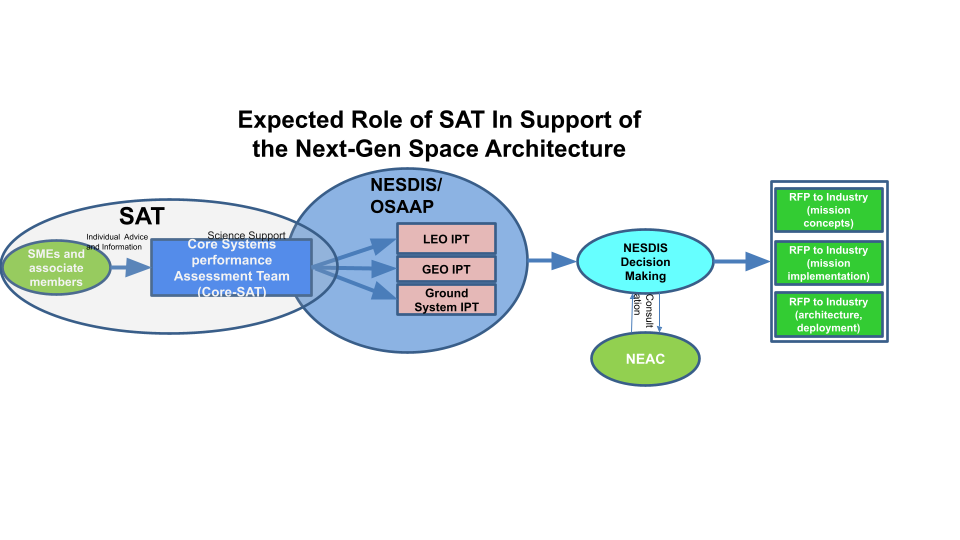
NESDIS is working on three next generation satellite systems : A next Generation GEO-Extended Orbit (GEO-XO) satellite constellation program -on Geostationary orbit-, the space weather program and the LEO program including a LEO sounder-focused small satellite system. The initial focus of the SAT will be on these systems but is expected to expand to support other IPTs for other observables (such as the enterprise ground architecture). The linkages of SAT to the rest of the processes leading to the release of RFPs to the industry are illustrated in the figure above.
Scope:
The SAT is an objective science, engineering and technology-oriented team and does not have an advocacy role for any specific sensor type or technology type. The SAT is dedicated to providing facts-based input, which accounts for multiple scientific and strategic factors so that decision-makers can make sound, informed decisions based on these Core-SAT’s recommendations. The Core-SAT team is composed of federal employees while the SAT overall team is composed of partners from federal agencies, and other non-federal partners.
SAT provides expert opinion, feedback, and technical assessment of scientific problems relating to architecture, formulation, and execution. The specific issues will be brought to the attention of SAT by various groups in NOAA and triaged through the SAT advisory board.
These issues may relate to:
- Determining users applications observational needs, current and future,
- Performing Impacts assessment experiments on users’ applications and systems,
- Performing scientific studies (impact assessment, geophysical capability evaluation, etc.) as needed
- Interacting with outside experts on an as needed basis.
- Providing support for the interaction, when needed and appropriate, with vendors, to optimize their selection and designs,
- Supporting the effort of the design and optimization of constellations.
- Reach out to users, stakeholders, and international partners to provide awareness, build support and seek feedback on the science requirements, and scientific tradeoffs.
The SAT is a science team and does not have an advocacy role. The SAT is dedicated to providing science-based input, which accounts for multiple scientific and strategic factors so that decision-makers can make sound, informed decisions based on the Core-SAT’s recommendations.
Members
The purpose of the Core Systems performance Assessment Team (Core-SAT) is to provide authoritative scientific and performance assessment support to NESDIS in its efforts to plan for the next generation of environmental remote sensing satellite programs. The primary area of support will be on codifying performance requirements and conducting scientific investigations to answer questions that arise in the course of architecture, formulation, and execution design steps and to assess resulting performances against NESDIS mission requirements. Core-SAT members must be federal employees.
In addition to the core-SAT members, the general SAT team has associate members who are subject matter experts (SMEs) in a diverse set of areas. The principal role of the Associate Members is to present briefings, provide individual opinions and thoughts on a diverse set of technical subjects related to sensors impacts and pros and cons of methodologies. Associate Members are under signed Non-Disclosure agreement (NDA) and no-Conflict of interest (COI) agreements in order to be able to participate in the SAT discussions. The Associate Members, who could be feds or non-feds, do not participate in decision-making or recommendation-making processes. The Core-SAT does not request or accept consensus advice from these Associate Members, nor will NOAA or NESDIS.
Members of the SAT are from a diverse set of institutions, including NOAA, other federal agencies, contractors, academic institutions, and the private sector. The driving factor in the membership selection is the right expertise to solve particular problems.
How to become a member
If you would like to become a permanent member of the SAT and contribute to all discussions related to next-generation space architecture, please send an email to the SAT co-chairs, Michael Bonadonna, Michael.Bonadonna@noaa.gov and Jordan Gerth, Jordan.Gerth@noaa.gov. If you are a federal employee with interest in becoming a Core-SAT member that drafts the actual recommendations, please indicate this in your e-mail. Agendas are distributed prior to the meetings so you have the option to attend only those meetings you find relevant.
Meetings
Meetings are held at a regularly scheduled time and location. Day, time, and location may be changed to meet the needs of the SAT membership. SAT meetings will be open for SAT members attendance, while core-SAT meetings will be open only to core-SAT members. The SAT chairs regularly brief the Executive Sponsor(s) as well as the IPTs on the activities of the SAT and to convey science feedback. Additional, longer meetings/workshops could be organized by the SAT, to have sustained focus on specific questions.
When appropriate, core-SAT recommendations are made available on the SAT website.
Recommendations
The Core-SAT members consolidate the feedbacks and science assessments from the general discussions and results presented on a topic into a coherent, fact-based, formal recommendation.
| Name | Description | Date |
|---|---|---|
| Assessment of Observational Needs for Ocean Heat Content | This report is based on the efforts, inputs, and discussions of the SAT. It describes the variables and attributes that are expected to be most important for Ocean Heat Content from current algorithms and future improvements. | 6/26/2025 |
| Assessment of Observational Needs for Sea Surface Temperature | This report is based on the efforts, inputs, and discussions of the SAT. It describes the variables and attributes that are expected to be most important for Sea Surface Temperature from current algorithms and future improvements. | 9/23/2025 |
| Guidance on Microwave Sounders | Scientific Guidance for the potential study and design of Microwave Sounders (for SounderSat and GEO-XO) | 09/17/2020 |
| Guidance on IR Sensor | Scientific Guidance for the Design of Hyperspectral Infrared Sensors Including: (1) Recommendation on the Prioritization of the Sensors Characteristics from a Global NWP perspective, and (2) Recommendations on the Use of ShortWave (SW) and/or LongWave (LW) Bands for Temperature and Moisture Sounding and data assimilation | 10/07/2020 |
| SAT Memo 3D Winds | Atmospheric Wind Profiles (3Dwinds): Assessment of Observing Systems Capabilities Alternatives and Value to NOAA | 12/21/2020 |
| ASPEN 22 Constellations GEO XO | Initial Results of the ASPEN-Based Assessment of the 22 GEO-XO Constellations | 08/18/2020 |
| Calibration Memo | Assessing Sounder Calibration Needs in the era of Smallsats/Cubesats | 05/12/2021 |
| SAT Memo Sounder Collocation | recommendations on the need (or not) to require that microwave and infrared sensors be collocated on the same platform. | 05/17/2021 |
| Legacy Sensors Memo | Assessing the Impact of Losing Legacy Satellites on NOAA Global & Regional NWP | 06/11/2021 |
| Observational Needs for Global NWP | Assessment of solution-agnostic observational needs for Global NWP | 03/04/2022 |
| Community Satellite Processing Package (CSPP) | This memo provides background information and recommendations on aspects related to potential options that NESDIS should consider for the next-generation ground architecture planning and implementation. This option might be of particular interest to the handling of the SNPP data when this sensor becomes tertiary after the launch and commissioning of the JPSS-2 satellite. | 04/25/2022 |
| Radio Frequency Interference | This memo provides background information and specific recommendations on RFI-related options that NESDIS should consider for the next-generation ground and space architecture planning and implementation. | 03/13/2023 |
| The Arctic Observing Mission - Highly Elliptical Orbit Observations | The Arctic Observing Mission (AOM) is a variation of the previous AIM-North mission concept with an expanded scope that is under consideration by the Government of Canada for implementation with international partners. | 06/12/2023 |
| Assessment of Solution-Agnostic Observational Needs for Global Navigation Satellite System-Radio Occultation (GNSS-RO) Data | RO is one of the most impactful observations for NWP and science. RO profiles contribute to weather, climate, and space weather observations. | 06/14/2023 |
| The Impact of Legacy Sensors on non-NWP Applications | This memo provides background information and recommendations and guidance for understanding the impact of continuing to operate legacy low earth orbiting instruments on non-numerical weather prediction (NWP) applications. | 06/15/2023 |
| Assessment of Solution-Agnostic Observational Needs for Atmospheric Composition in Climate Monitoring | Atmospheric composition in climate monitoring is important for understanding and predicting changes to local and global climate. | 8/4/2023 |
| Assessment of Solution-Agnostic Observational Needs for Stratospheric Composition | This memo provides background information and recommendations and guidance for solution-agnostic observational needs for Stratospheric Composition. | 8/4/2023 |
| Assessment of Solution-Agnostic Observational Needs for Air Quality Monitoring and Forecasting | This memo provides background information and recommendations and guidance for solution-agnostic observational needs for Air Quality. | 8/4/2023 |
| Assessment of Solution-Agnostic Observational Needs for Nowcasting Applications of Fire Monitoring | This memo provides background information and recommendations and guidance for solution-agnostic observational needs for Nowcasting Applications of Fire Monitoring | 5/1/2024 |
| Assessment of Solution-Agnostic Observational Needs for Nowcasting Applications of Thunderstorm Forecasting | This memo provides background information and recommendations and guidance for solution-agnostic observational needs for Nowcasting Applications of Thunderstorm Forecasting, including storm severity, mode, and environment | 5/1/2024 |
| Assessment of Solution-Agnostic Observational Needs for Nowcasting Applications of Winter Precipitation Forecasting | This memo provides background information and recommendations and guidance for solution-agnostic observational needs for Nowcasting Applications of Winter Precipitation Forecasting | 5/1/2024 |
| Assessment of Solution-Agnostic Observational Needs for Nowcasting Applications of Dense Fog and Ceiling Monitoring and Forecasting | This memo provides background information and recommendations and guidance for solution-agnostic observational needs for Nowcasting Applications of Dense Fog and Ceiling Monitoring and Forecasting | 5/1/2024 |
| Assessment of Solution-Agnostic Observational Needs for Nowcasting Applications of Flood Forecasting | This memo provides background information and recommendations and guidance for solution-agnostic observational needs for Nowcasting Applications of Flood Forecasting | 5/1/2024 |
Documents
These documents are a collection of results and presentations given at SAT meetings, as well as other documents relevant to the SAT and the ASPEN project.
- Meeting Documents
- Organizational Documents
- ASPEN Documents
- Publications
- Technical Reports
- Reference Documents
| Title | Theme | Presenter | Date |
|---|---|---|---|
| Overview of Existing and Upcoming Microwave and Infrared Sounders Characteristics: Both Classic and Smallsat Types | Supporting SounderSAT Internal Government Design for MW and IR Sounders | Flavio Iturbide-Sanchez | 8/17/2020 |
| Spectral Characteristics of Infrared Sounders: Classic and Smallsat Types | Hyperspectral Bands Selection Choices: Recommendation and Assessment of Pros and Cons | Flavio Iturbide-Sanchez | 8/31/2020 |
| Exploitation of Shortwave IR sounder observations in NOAA Global NWP | Hyperspectral Bands Selection Choices: Recommendation and Assessment of Pros and Cons | Kevin Garrett | 8/31/2020 |
| Description of Infrared Longwave, Midwave, and Shortwave Bands | Hyperspectral Bands Selection Choices: Recommendation and Assessment of Pros and Cons | Eric Maddy | 8/31/2020 |
| Experience using 3D winds from ESA's Aeolus: Impact on NWP | Atmospheric 3D Winds: Recommended approach | Kevin Garrett | 9/14/2020 |
| Obseving System Simulation Experiments to Evaluate the Potential Impact of Alternative Technologies for Space-Based Lidar Winds on Numerical Weather Prediction: | Atmospheric 3D Winds: Recommended approach | Robert Atlas | 9/14/2020 |
| Assessment of 3D-Winds technologies, capabilities, and impacts | Atmospheric 3D Winds: Recommended approach | Lidia Cucurull | 9/14/2020 |
| Comparison of Aeolus winds to AIRS 3D winds | Atmospheric 3D Winds: Recommended approach | Dave Santek | 9/14/2020 |
| POES Legacy Studies Impacts from sunsetting legacy Satellite Platforms | Assessing Impact of Losing the Legacy Satellites on the Global NWP | Kevin Garrett | 9/28/2020 |
| Linking the Future of Data Assimilation to Future Observables | Discussing the evolution of NWP (UFS) and its Corresponding Requirements of the future | Will McCarty | 11/9/2020 |
| ASPEN: Advanced Systems Performance Evaluation for NOAA | Discussing the evolution of NWP (UFS) and its Corresponding Requirements of the future | Stacy Bunin | 11/9/2020 |
| Future Observational Needs for NWP | Discussing the evolution of NWP (UFS) and its Corresponding Requirements of the future | James G. Yoe | 11/9/2020 |
| Review of NOAA Unified Forecast System Future Observation Needs | Discussing the evolution of NWP (UFS) and its Corresponding Requirements of the future | Kevin Garrett | 11/9/2020 |
| Should MW and IR Sensors be collocated on the same platforms? (and other similar questions) | Should sensors and IR bands be collocated (and co-aligned) | Sid Boukabara | 11/23/2020 |
| On the CubeSat sounding Systems | Quality, Quantity or Both?: Discuss LEO swarm of small sensors (esp. sounders). What impact(s) could this have on overall architecture performance? | Jun Li | 12/7/2020 |
| Potential Benefits Cubesat constellation | Quality, Quantity or Both?: Discuss LEO swarm of small sensors (esp. sounders). What impact(s) could this have on overall architecture performance? | Likun Wang | 12/7/2020 |
| Sensors MW Accuracy Overall Assessment | Discussion on SmallSats, Quantity vs Quality (and/or both) | Eric Maddy | 2/1/2021 |
| SounderSAT: Trade Space Assessment & Value-Based Formulation Recommendation | Discussion on SmallSats, Quantity vs Quality (and/or both) | Sid Boukabara | 2/1/2021 |
| ASPEN Analysis: Inputs | Discussion on SmallSats, Quantity vs Quality (and/or both) | Stacy Bunin | 2/1/2021 |
| SAT Discussion on Smallsats: Quality vs Quantity | Discussion on SmallSats, Quantity vs Quality (and/or both) | Sid Boukabara | 2/1/2021 |
| Overview of CrIS SW-band versus LW-band experiments | Sensor design: As we did with IR, evaluate sounding bands trades for MW. Traditional versus high frequency channels (118vs 50 GHz for exp) | Chris Barnet | 3/1/2021 |
| Assessment of the Information Content of Hyperspectral Infrared Sounder | Sensor design: As we did with IR, evaluate sounding bands trades for MW. Traditional versus high frequency channels (118vs 50 GHz for exp) | Eric Maddy | 3/1/2021 |
| Advanced IR Sounder Nature and Role for the Next NOAA Spaceborne Architecture | Sensor design: As we did with IR, evaluate sounding bands trades for MW. Traditional versus high frequency channels (118vs 50 GHz for exp) | Hank Revercomb | 3/1/2021 |
| Importance of Satellite Calibration | Assessing the Sensors Calibration Needs in the era of smallsats/cubesats (Part 1) | Will McCarty | 3/15/2021 |
| Overview of NRL MW Calibration Efforts, Detection of MW Radiance Biases and Variational Bias Correction (VarBC) Schemes | Assessing the Sensors Calibration Needs in the era of smallsats/cubesats (Part 1) | Steve Swadley | 3/15/2021 |
| Assessing the Sensors Calibration Needs in the era of smallsats/cubesats | Assessing the Sensors Calibration Needs in the era of smallsats/cubesats (Part 1) | Flavio Iturbide-Sanchez | 3/15/2021 |
| Radiance Bias Correction and the Use of TDR/SDR Microwave Radiances at NCEP | Assessing the Sensors Calibration Needs in the era of smallsats/cubesats (Part 1) | Emily Liu | 3/15/2021 |
| Error handling for satellite radiance observations in NWP | Assessing the Sensors Calibration Needs in the era of smallsats/cubesats (part 1) | Tony McNally | 3/15/2021 |
| Assessing the Sensors Calibration Needs in the era of smallsats/cubesats: Summary | Calibration discussion Round ll | Flavio Iturbide-Sanchez | 3/29/2021 |
| TROPICS: Time-Resolved Observations of Precipitation structure and storm Intensity with a Constellation of Smallsats | Part I: Followup Discussion on Calibration and example of TROPICS Part II: Introducing SAT Team: Purpose, Membership, Tools, Website, Documentation | William Blackwell | 4/12/2021 |
| ASPEN: Advanced Systems Performance Evaluation tool for NOAA | Part I: Followup Discussion on Calibration and example of TROPICS Part II: Introducing SAT Team: Purpose, Membership, Tools, Website, Documentation | Stacy Bunin | 4/12/2021 |
| Driving Applications: Models and Forecasts in ASPEN (initial inputs provided by ASPEN Team) | Identifying the highest importance users applications and MSAs that should drive the LEO constellation | Stacy Bunin | 5/10/2021 |
| Application Drivers for Observations | Identifying the highest importance users applications and MSAs that should drive the LEO constellation | Mitch Goldberg | 5/10/2021 |
| Summary of WIGOS 2040 Orbit Deployment | In designing a constellation of Sounders orbits | Stacy Bunin | 5/24/2021 |
| An Overview of Microwave Imagers | Microwave Imagers | Stacy Bunin | 6/7/2021 |
| POES Legacy Impacts | Legacy Sensors Impact (from non-NWP perspective) | Mitch Goldberg | 6/21/2021 |
| The value of Two Satellites in the Same Orbit for Nowcasting and Climate Monitoring | Legacy Sensors Impact (from non-NWP perspective) | Mitch Goldberg | 6/21/2021 |
| Science from a Hyperspectral Sensor | Discussion on the feasibility of a Hyperspectral Microwave Sensor | Christian Kummerow | 7/12/2021 |
| Progress and Outlook for a Future Hyperspectral Microwave Sounder | Discussion on the feasibility of a Hyperspectral Microwave Sensor | William Blackwell | 7/12/2021 |
| Implementation Feasibility Considerations for a Hyperspectral Microwave Sensor | Discussion on the feasibility of a Hyperspectral Microwave Sensor | Edward Kim | 7/12/2021 |
| Benefits of HyMs Sensor | Discussion on the feasibility of a Hyperspectral Microwave Sensor | Eric Maddy | 7/12/2021 |
| The Driving Applications in ASPEN and a suggested process to inform NOAA about the community's diverse set of corresponding Observational needs | Observational Needs of the NOAA Technical Systems and Driving Applications: Assessment and Refresh | Stacy Bunin | 8/9/2021 |
| Space Platform Requirements Working Group (SPRWG)-Methodology and Main Results” | Observational Needs of the NOAA Technical Systems and Driving Applications: Assessment and Refresh | Richard Anthes | 8/9/2021 |
| Stewardship and Use of NOAA’s Observational Technical Needs | Observational Needs of the NOAA Technical Systems and Driving Applications: Assessment and Refresh | David Helms and Meredith Wagner | 8/9/2021 |
| Translating User Needs into User Requirements | Observational Needs of the NOAA Technical Systems and Driving Applications: Assessment and Refresh | Vanessa Escobar, Renata Lana, Kat Hawley | 8/9/2021 |
| Reviewing and Updating Requirements for Global NWP | Focused discussion on global NWP observation needs. | Richard Anthes | 8/23/2021 |
| Requirements for Global NWP in ASPEN Tables (Requirements and Priorities) | Focused discussion on global NWP observation needs (Part ll) | Richard Anthes | 9/20/2021 |
| Overview of Observational Needs Assessment | Focused discussion on global NWP observation needs (Part lll) | Sid Boukabara | 10/4/2021 |
| Assessment of Users Observational Needs SAT Consolidation of Requirements Ranges and Priorities for Global NWP | Focused discussion on global NWP observation needs (Part lll) | Stacy Bunin | 10/4/2021 |
| Review of NOAA Unified Forecast System Future Observation Needs | Focused discussion on global NWP observation needs (Part lll) | Kevin Garrett | 10/4/2021 |
| Approaching the Oceans and Coasts | Focused discussion on global NWP observation needs (Part lll) | Michael Ford | 10/4/2021 |
| Suomi-National Polar-orbiting Partnership (S-NPP) in the Joint Polar Satellite System-2 (JPSS-2) Era | Finalizing GNWP observational needs & Brainstorming potential ideas for S-NPP use (post-J2 entering operations) and GOES-15 use (post GOES-T entering operations) from a science perspective | Becky Mesarch | 10/18/2021 |
| Advances in Hyperspectral Microwave sounding from Space | Quantitative assessment of observing systems values as they pertain to the Next-Gen Space Architecture planning | Antonia Gambacorta | 11/29/2021 |
| SAT Consolidation of Requirements Ranges and Priorities for Nowcasting - Flood Forecasting | Observational needs assessment for Nowcasting Applications. | Jordan Gerth | 1/10/2022 |
| SAT Consolidation of Requirements Ranges and Priorities for Nowcasting - Thunderstorms, including storm severity, mode, and environment | Observational needs assessment for Nowcasting Applications. | Jordan Gerth | 1/10/2022 |
| SAT Consolidation of Requirements Ranges and Priorities for Nowcasting - Winter precipitation, type and quantity including lake-effect snow | Observational needs assessment for Nowcasting Applications | Jordan Gerth | 1/10/2022 |
| SAT Consolidation of Requirements Ranges and Priorities for Nowcasting - Offshore winds and sea ice, including cyclones | Observational needs assessment for Nowcasting Applications | Jordan Gerth | 1/10/2022 |
| Ranges and Priorities for Nowcasting: Fire Monitoring (Wild and Urban) | Observational needs assessment for Nowcasting Applications | Jordan Gerth | 1/10/2022 |
| SAT Consolidation of Requirements Ranges and Priorities for Nowcasting - Dense Fog and Ceiling, considering impacts to Aviation | Observational needs assessment for Nowcasting Applications | Jordan Gerth | 1/10/2022 |
| NESDIS Ground Enterprise Study NGES | Next-Gen Ground Enterprise: What is it, what are the plans, and what are the next steps. | Ra'ad Saleh | 3/7/2022 |
| Community Satellite Processing Package (CSPP) | CSPP briefing | Allen Huang | 3/21/2022 |
| Towards consistent exploitation of Earth system observations in coupled assimilation systems for NWP and reanalysis". | Future observational needs of the ECMWF Earth System prediction model | Patricia de Rosnay | 4/4/2022 |
| LEO Orbital Deployment of Sounders (MW and IR): Temporal Refresh | LEO Orbital Deployment of Sounders | Valerie J. Mikles/Bruce Campbell | 4/11/2022 |
| Satellite Ocean Surface Winds: The why and How and What Should We Do Next | Ocean Surface Winds Overview and applications | Paul S. Chang | 5/2/2022 |
| CISESS Next-gen Ground Architecute | Feedback from CIs on NESDIS next-gen Ground Architecture | Isaac Moradi | 5/9/2022 |
| CIMSS Perspectives on NESDIS Next Generation Ground Architecture | Feedback from CIs on NESDIS next-gen Ground Architecture | Liam Gumley | 5/9/2022 |
| CIRA Feedback on NOAA Ground architecture planning | Feedback from CIs on NESDIS next-gen Ground Architecture | Andrew Jones | 5/9/2022 |
| Assessment of Users' Observational Needs | |||
| SAT Consolidation of Requirements Ranges and Priorities for Atmospheric Composition Monitoring and Forecasting | Atmospheric Composition applications | Brad Pierce, Shobha Kondragunta, Larry Flynn, Greg Frost, Monika Kopacz | 5/16/2022 |
| Future RO needs-NOAA request final | Characteristics of GNSS-RO data for Advanced Planning | Richard Anthes | 6/27/2022 |
| NESDIS Commercial Data Program Status | Characteristics of GNSS-RO data for Advanced Planning | Patricia Weir | 6/27/2022 |
| The Atmosphere Observing System (AOS) Constellation | Deep dive discussion on NASA’s AOS mission | Scott Braun, Jason Hair, Emily Berndt, Jonathan Chrone | 7/11/2022 |
| QOSAP activities in support of the next generation of satellite architecture at NOAA | QOSAP main assessment activities (OSEs, OSSEs) and results, in support of space architecture planning: for LEO, GEO | Lidia Cucurull | 7/25/2022 |
| Constellations of Smallsats/Cubesats to Provide Global, Hourly Observations | Feasibility, Benefits, and Challenges of Deploying Smallsats/Cubesats constellation(s) -Case of Microwave Sounders | Stan Kidder/Tom VonderHaar | 8/22/2022 |
| Thoughts On: Feasibility, Benefits, and Challenges of Deploying Smallsat/Cubesat Constellation(s) - Case of Microwave Sounders | Feasibility, Benefits, and Challenges of Deploying Smallsats/Cubesats constellation(s) -Case of Microwave Sounders | William Blackwell | 8/22/2022 |
| SmallSat Data Exploitation Update | Feasibility, Benefits, and Challenges of Deploying Smallsats/Cubesats constellation(s) -Case of Microwave Sounders | Min-Jeong Kim /Kevin Garrett | 8/22/2022 |
| Improving Temporal Sampling of Microwave Sounders using SmallSats/CubeSats: Perspectives from Experience Gained from the TEMPEST-D NASA Earth Venture Technology Mission | Feasibility, Benefits, and Challenges of Deploying Smallsats/Cubesats constellation(s) -Case of Microwave Sounders | Steven Reising | 8/22/2022 |
| Overview of NOAA BAA Studies In support of NESDIS Next-Generation Space and Ground Architecture Planning | Overview of NOAA BAA Studies to Help Next-Gen Architecture Planning | David Spencer,Sid Boukabara | 10/17/2022 |
| Excerpts from 5G Study Outbrief | RFI for Next-Gen Architecture Planning | David Spencer | 10/31/2022 |
| NASA RFI Activities Overview | RFI for Next- Gen Architecture Planning | Edward Kim | 10/31/2022 |
| Radio Frequency Interference (RFI) Detection-Risk Perspective | RFI for Next- Gen Architecture Planning | Otto Bruegman | 10/31/2022 |
| User Engagement Information and ASPEN | Socio-Economic Value Assessment | Renata Lana /Vanessa Escobar | 11/14/2022 |
| PRSSO/NESDIS Coordination | Socio-Economic Value Assessment | Monica Grasso/Joseph Conran | 11/14/2022 |
| JPSS Perspective | Socio-Economic Value Assessment | Satya Kalluri | 11/14/2022 |
| Socioeconomic impact of VIIRS Observations | Socio-Economic Value Assessment | Matthew Rogers | 11/14/2022 |
| Excerpts from 5G Study Outbrief to Griffin and Mandt on Oct 14, 2020 | RFI for Next-Gen Architecture Planning (Part II) | David Spencer | 11/28/2022 |
| RFI Discussion Part 2 | RFI for Next-Gen Architecture Planning (Part II) | Edward Kim | 11/28/2022 |
| Comparative OSE-based Assessment of space- based atmospheric wind, on NOAA's NWP (AMVs, Aeolus and MW/IR sounders series) | Assessing Atmospheric Wind information on NWP from Multiple Observing systems | Narges Shahroudi | 12/12/2022 |
| Update on OSSE results with 3D Winds from Space | Assessing Atmospheric Wind information on NWP from Multiple Observing systems | Lidia Cucurull | 12/12/2022 |
| Earth-2: Digital Twins for Weather and Climate | Earth System Approach and Digital Twins: Focus on case study: NVIDIA's Earth-2 | Karthik Kashinath, NVIDIA | 1/23/2023 |
| Review of Earth System Environment Variable | Description of the Earth System and its components | Stacy Bunin | 2/6/2023 |
| Investigation of Convective Updrafts | INCUS Satellite Mission | Ziad S. Haddad | 3/6/2023 |
| The Arctic Observing Mission (AOM) | The Arctic Observing Missing (AOM) a Canadian-led mission concept for quasi-geostationary observations of the North | Ray Nassar and the AOM Team | 04/03/2023 |
| Description of the Earth System Environment | Review of Earth System Environment Variables | Stacy Bunin | 06/12/2023 |
| Re-examining Cryosphere Applications and Requirements in WMO | Cryosphere Monitoring efforts | Jeff Key | 07/10/2023 |
| Status of Activities Supporting the Space Weather Observations (SWO) Office | SWFO Status and other activities | Dimitrios Vassiliadis | 8/7/2023 |
| Attributes of Earth System Variables for Comparing Observing System Performances to Application Requirements | Attributes of variables that help describe the Earth system | Ross N. Hoffman | 9/18/2023 |
| SAT Overview October 2023 | SAT Meeting: SAT & SUNWG Coordination discussion | Michael Bonadonna | 10/30/2023 |
| SUNWG SAT Presentation | SAT Meeting: SAT & SUNWG Coordination discussion | Andrew Heidinger | 10/30/2023 |
| Refresh/Revisit Rate Definitions and Application to NOAA Constellations | Refresh/Revisit Rate Definitions | Scott Schnee | 12/11/2023 |
| Name | Description | Date |
|---|---|---|
| Terms of Reference | Describes the background, scope, composition, and roles and responsibilities of the SAT | 05/07/2020 |
| Participation Agreement | Participation Agreement for Associate Membership on the SAT: Non-disclosure agreement | 05/07/2020 |
| Name | Description | Date |
|---|---|---|
| ASPEN ARR Template | Template for the Application-dependent Requirements Range table | 03/23/2021 |
| ASPEN ATP Template | Template for the Application-dependent Technical Priorities table | 03/23/2021 |
| ASPEN ARR-ATP Guidance | Guidance for how to fill out the ARR and ATP tables | 03/30/2021 |
| ASPEN SCP Guidance | Guidance for how to fill out the SCP table | 03/23/2021 |
| ASPEN SCP Template | Template for Sensor/Constellation-based Performances | 03/23/2021 |
| Name | Description | Corresponding Author | Date |
|---|---|---|---|
| ASPEN: A Dynamic Tool to Assess the Benefit and Value to NOAA of Space and Ground Based Observing Systems | This paper is a work in progress | Sid Boukabara, NOAA/NESDIS/STAR | |
| Developing Priority Observational Requirements from Space using Multi-Attribute Utility Theory | Richard Anthes, UCAR | 4/10/2019 |
| Name | Description | Date |
|---|---|---|
| Assessment of Solution-Agnostic Observational Needs for Global Numerical Weather Prediction (NWP) | This report is based on the efforts, inputs, and discussions of the SAT. It describes the variables and attributes that are expected to be most important for global NWP in the 2030 timeframe. | 6/21/2022 |
| Name | Description | Date | Type |
|---|---|---|---|
| NOSC Impact Assessment Framework Memo | Guidance on the Process to Define, Design, Execute, Review & Report on Observing Systems Value and Impact Assessments | 07/25/2022 | Memo |
Announcements
| Announcement | Details | Relevant Date(s) |
|---|---|---|
| Announcement | Details | Relevant Date(s) |
|---|---|---|
| VIIRS User Meeting - Celebrating 10 years of SNPP | JPSS is holding a two-day virtual workshop to hear from key users about how VIIRS products and applications are benefitting organizations to meet their mission goals in serving their stakeholders and society | The first day of the virtual meeting will be held on June 29, 2022 |
| VIIRS User Meeting - Celebrating 10 years of SNPP | JPSS is holding a two-day virtual workshop to hear from key users about how VIIRS products and applications are benefitting organizations to meet their mission goals in serving their stakeholders and society | The second day of the virtual meeting will be held on June 30, 2022 |
Contact Us
For any questions, comments or suggestions, feel free to contact us:
- Michael Bonadonna | SAT Co-chair | Michael.Bonadonna@noaa.gov
- Jordan Gerth | SAT Co-chair | Jordan.Gerth@noaa.gov